1964
Children of the Corn1964 is the pivotal year in Gatlin’s hidden history, the point at which Burt’s scattered clues lead him to infer that the town’s children turned against their parents and made corn worship the basis of a new community order. The year remains partly obscured by incomplete records and Burt’s reconstruction, but its consequences reach into the town’s church, sacred objects, and later age-based sacrifices.
The year behind the town’s records
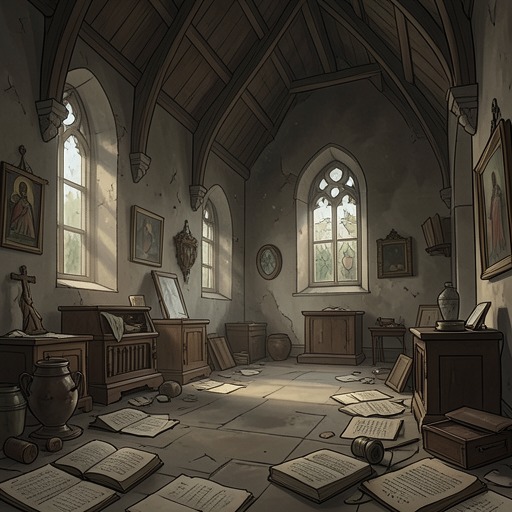
Burt encounters the date indirectly, through a church that has changed its identity and records that appear to have been kept by a child. A ledger’s last entry is for Ruth Clawson, born in 1961; another volume continues the list into early September 1964, recording Job Gilman’s birth, then Eve Tobin’s birth in June 1965. A third book is blank. The surviving entries do not explain the break, but their abruptness makes the records evidence of a disruption rather than a continuous account of ordinary church life.
The church’s material clues reinforce that impression. Its former name, Grace Baptist Church, has been removed, while a book bears the slogan that the unrighteous must be cut down so the ground can become fertile again. A sermon board names He Who Walks Behind the Rows and gives a date in 1976, showing that the congregation’s changed religious language endured well beyond the year Burt is investigating. Against that later evidence, the gap in the records gives 1964 the force of an origin point, though not a fully documented one.
Burt’s reconstruction of the rupture
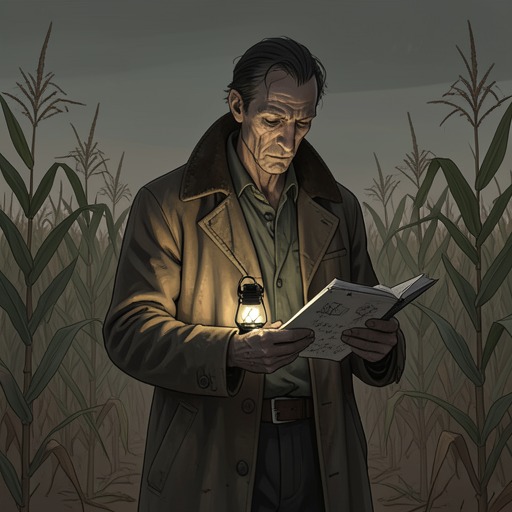
Standing in the church, Burt concludes that something happened in 1964 involving religion, corn, and children. He imagines a community isolated among the fields, whose religious mania turned the crop’s condition into a reason for violence. This is his interpretation of the evidence, not a complete account preserved by the town: the books identify dates and names, but do not state what happened to the adults or why.
Burt gives that inference a more specific shape when he tells Vicky about Richard Deigan, who took the biblical name Amos in 1964. In Burt’s reconstruction, Deigan and a circle of other young people killed their parents, believing that sacrifice was needed because the corn might be dying through insufficient sacrifice. Burt also suspects that the children imposed an age limit on their own lives: Deigan turned nineteen on September 4, 1964, and Burt thinks he may have been sacrificed on that birthday. The account connects the town’s apparent break with its former order to a new system of religious authority, but remains explicitly a story Burt assembles from clues.
Religious traces and later consequences
The new faith is visible in the objects and public signs Burt and Vicky encounter. A crucifix fashioned from dried corn husk and a small cob uses kernels to form a figure; its carefully removed kernels and raised letters make agricultural material serve as a Christian emblem. Elsewhere, a radio preacher speaks of atonement, while Gatlin’s church board proclaims the power of He Who Walks Behind the Rows. These details place familiar Christian forms beside a local theology in which corn and sacrifice are central.
The rules associated with that order do not remain fixed. Later, Isaac declares that the Age of Favor has been lowered from nineteen plantings and harvestings to eighteen. The change brings Malachi and Joseph, the two eighteen-year-olds present, within the group expected to enter the corn; other eligible young people remain in town. The announcement shows a community treating age as a religious threshold that can be revised, while the recorded beginnings of the order still point back to 1964.
The year’s legacy also appears in the practices that follow. After Isaac speaks, the girls make many corn-cob crucifixes in the hope of warding off further evil. That night, those above the Age of Favor walk to the clearing to seek the continued favor of He Who Walks Behind the Rows. The repeated use of corn as both sacred material and the setting for sacrifice gives Burt’s inferred history an ongoing presence: 1964 is not simply a vanished episode, but the rupture from which Gatlin’s altered religious life develops.